Play It Loud

everything you need to know about guitar chords

Everything You Need To Know About Guitar Chords: The Definitive Guide

There are many reasons why you may have stumbled here to this article about guitar chords. 

My goal is to cover most of the big topics about learning this crucial aspect about guitar so that you’ll be well equipped to learn almost any song on Ultimate Guitar….

Or that you’ll get some of the nagging questions about them answered because your teacher or “free” course didn’t cover it. 

Simply put, a guitar chord is a set of notes played together at the same time. 

However, it’s not that simple to get them entirely, which is why I wrote this article…..

So, What Are Guitar Chords?

There’s powerchords. 

There’s “open” chords. 

And then there’s major, minor, barre, 7ths, sus, slash, altered, lydian, 9s 11s and 13s. 

I once tried memorizing as many as possible from a chord book I bought at Austin’s music in my hometown of Oxford, MS, which was a complete waste of time as the songs I was learning only used two main types…

(I’ll get to those later in this article) 

Like I said in the intro, a chord is just anything that consists of two notes played at the same time. 


There’s a “dyad” like the powerchord: 
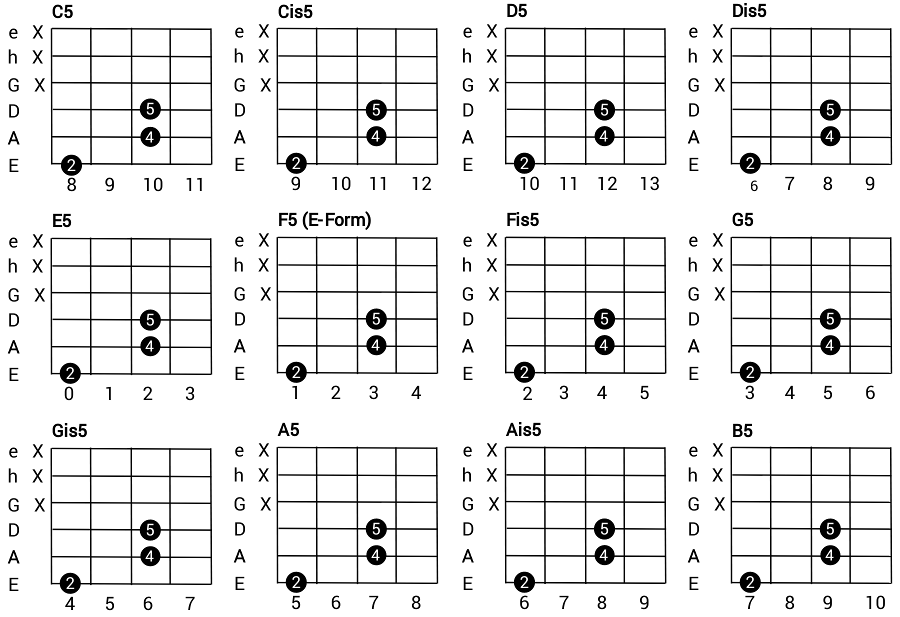
power chords guitar chord chart

There’s the basic open chords: 

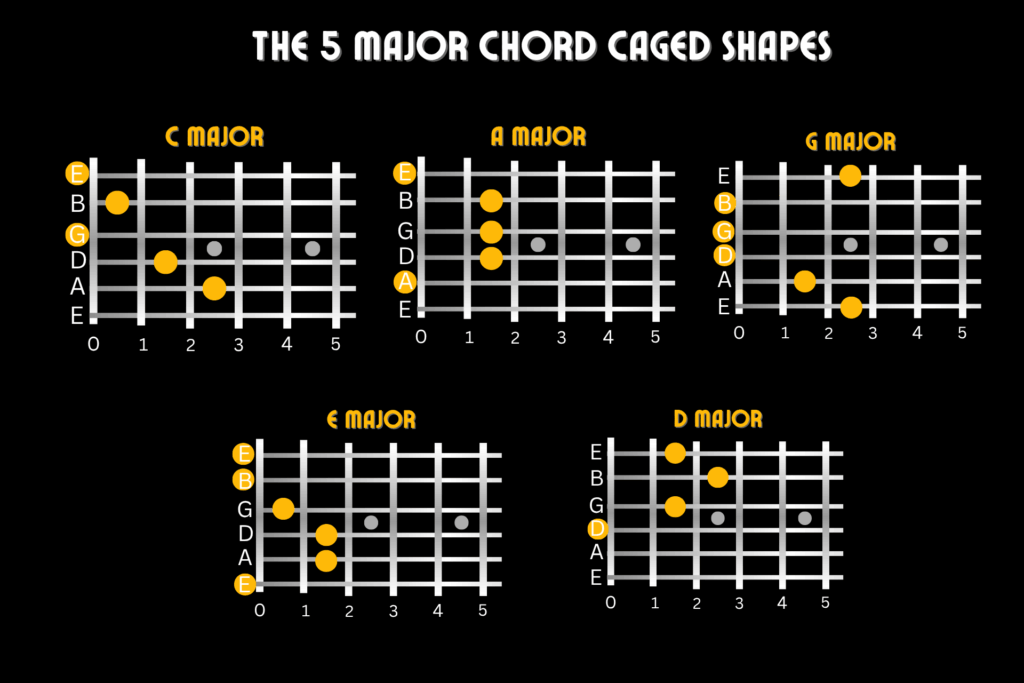
caged guitar chord shape types


Maybe you’ve guessed it by now. 

These are the chords that’ll get you through nearly 90% of songs out there if you’re wanting to learn the most well known riffs and chord progressions. 

I really mean that! 

However, you’ve got to learn about “shapes” and how to recognize them in a chord chart or diagram…..

How To Read A Guitar Chord Diagram

C major is one of the easiest chords to learn first as you just need two fingers to play it. 

Now I hate repeating what other articles about guitar chords and youtube videos about guitar chords have gone through, but let’s wrap it up quickly: 

  1. The guitar has 6 strings, represented by the vertical lines. 
  2. The guitar has 21 to 24 frets, depending on the guitar, represented by the horizontal lines. 
  3. Many chord diagrams will force you to identify which frets on which strings to play
  4. A number on top of a dot or fret is telling you what finger to use on that fret
  5. Finger 1 is your index/pointer finger, finger 2 is your middle finger, finger 3 is your ring finger, and finger 4 is your pinky. 
  6. If you see an X next to a string on the vertical line, don’t play it. Mute it or avoid it. 
  7. An open circle above a vertical line means to play it “open”, which means no fretting. Open chords come from the idea of playing “open” strings. 


That’s it for READING a chord diagram. Playing these chords and switching between them is a whole other ball game I’ll get to in a later section. 

I think it’s very useful to know what SHAPES to look out for first when you’re starting on chords. 

This way, you’ll be able to more easily remember them and identify them when learning new songs. 

8 Basic Guitar Chord Shapes Beginners Should Know

caged guitar chord shape types

We have something called the CAGED system which is a more intermediate level concept that helps with improvising guitar solos and fills, but it will help you too for you beginners out there. 

Now don’t worry about seeing the CAGED pattern across the fretboard. That’s the advanced stuff. 

Just remember that word/acronym: CAGED. 

These are the 5 core chord shapes that’ll drive almost every riff and progression you’ll play: 

  1. The C shape: X32010. Move it to D on the 5th string, it becomes X54232, D major. To G, X-10-9-7-8-7, G major. And so on. 
  2. The A shape: X02220. Move it to C at the 3rd fret on the 5th string, it becomes X35553, C major. To E, X79997, E major. It repeats itself just like the last shape. 
  3. The G shape: 320033. Move it to A at the 5th fret on the low E string, it becomes 542225, A major. Move it to B on the low E string, it becomes 764447, B major. 
  4. The E shape: 022100. Move it to G at the 3rd fret on the low E string, it becomes 355433, G major again. Go back to F on the low E string at the 1st fret, and it becomes that scary F chord from earlier, 133211. 
  5. The D shape: XX0232. Move it to the 2nd fret on the D string, it becomes XX2454, E major.. Go to the 7th fret of the D string, it becomes X-X-7-9-10-9, A major again. 


The guitar is a system of chord shapes and scale patterns that interconnect and form the basis of another core musical concept called a “key signature.” 

When we say we’re in C major, we’re in the key of C major. In E minor, key of E minor. 

Which brings me to my next point before moving on to the next section……

What makes a chord major or minor? 

Well you just learned a bunch of major chords, and I’ve been assuming you’ve started learning the notes of the fretboard. That’s very crucial if you want to memorize songs and riffs easier by the way…..

However, to the point, every major or minor chord is going to be made up of 3 notes: the root, the note creating a “3rd” from the root, and the note creating a “5th” from the root. 

To keep it simple, let’s just try to turn E major into E minor. 

3 notes: E (the root), G# (the 3rd), and B (the 5th)

LOWER the 3rd by one fret, to G, and keep the other two notes. 

Now you have E, G, and B. 

022100 has become 022000
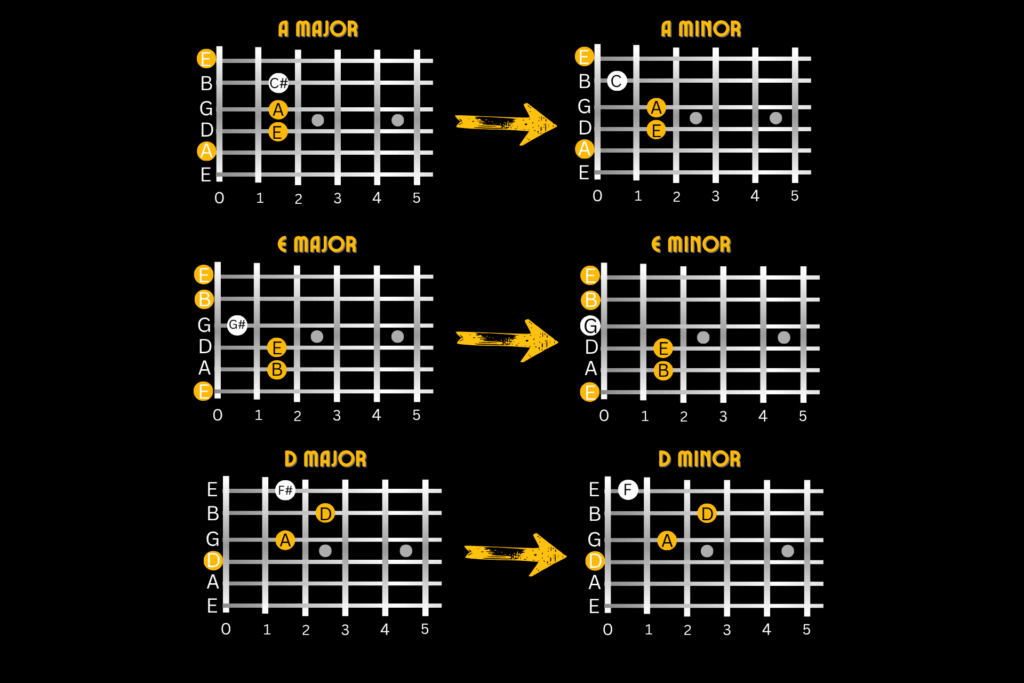
change guitar chords major to minor

And that’s where the other crucial shapes come from outside of CAGED, which if you’re quick you may have noticed I haven’t given you 3 of the 8 shapes I promised. 

  1. E minor: 022000, which this shape becomes 577555 for Am, and 799777 for Bm, for example. 
  2. A minor: X02210 (from the A shape of X02220, lowered the 3rd of C# to C). X35543 becomes Cm, and X79997 becomes Em by lowering the 3rd there, X79987
  3. D minor: XX0231 (from D shape of XX0232). Hopefully you get the point about moveable shapes by now

To make anything MAJOR from minor….just find the 3rd and increase it. 

Now look. This is a lot of info. I get it. 

This wouldn’t be a complete guide to guitar chords if I didn’t cover this. 

So if you want some takeaways I can sum for ya, here they are: 

  1. Remember and start finding those CAGED chords from earlier
  2. Try your best to learn the fretboard and start trying to find the 3rd in the chord shapes you’ve already learned. 

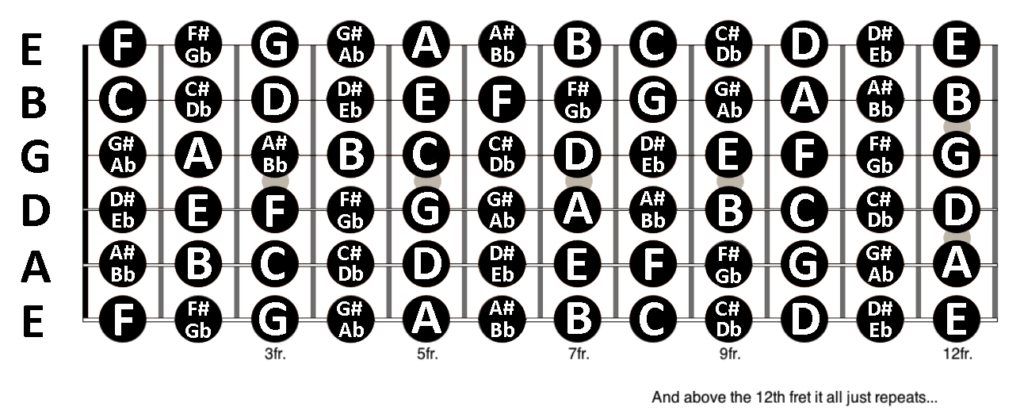
Here’s a fretboard image you can save to your phone to start learning these chords as a reference: 
Changing Guitar Chords Quickly Easily

In order to help you avoid a lot more reading, I’m going to also make some very simple videos showing some of the ideas behind switching guitar chords as easily as possible. 

Basically, the easiest chord changes will be where most or all of your fingers stay in one place, like Fleetwood Mac’s “Dreams” or “Horse With No Name.”

The hardest chord changes will involve changing fretboard positions, like going from open position to the 5th fret for an example, while also changing which strings your fingers need to go to. 

Here’s some other considerations to take when you start attempting to change chords: 

  • Please please please avoid lifting your hand off the fretboard and putting it back on when making a chord change
  • Keep your wrist in a position where your thumb can rest easily on the back of the neck. This way your fingers can lay flat against the fretboard PERPENDICULAR to the fretboard. I’ll show in a video below what I mean. 
  • At first, work on remembering the fingerings for the 8 chord shapes mentioned earlier. Switching chords is really really tough if you can’t remember where your fingers go. 
  • Once the last point is mostly out of the way, start trying to see where your fingers can stay or where they can easily move from one string to another
  • When you start using the technique we call strumming, if you’re struggling to get all your fingers in place, just try to get the first note you’ll hit in place. 


Here a video showing exactly what I mean by minimizing movement: 

I know this seems like a lot of work when you’re just reading it and trying to understand what I’m talking about. 

Remember. The best thing to do now is just attempt this. No one ever gets right the first time. Everyone struggles with the basic chords at first because no one has the muscle memory yet. 

And it’s really easy to forget the fingerings, to hit the wrong notes because your finger’s not in the right place, and to get your picking hand to cooperate all while playing in time with the song. 

The next section is all about getting you started with trying this all out…..

Easy Guitar Chord Progressions To Practice

So my goal here is not give you a bunch of chord changes that don’t match a song you can recognize. 

Learning how to use guitar chords helps a lot if you’ve got some easy guitar chord songs to play on day one. 

Hopefully this is a good enough variety to satisfy a lot of you: 

  • Dreams: Fmaj7 3210 to G6 5430 
  • Can’t Buy Me Love: Em to Am 
  • Horse With No Name: Em to D/F#
  • Folsom Prison Blues: E to A 
  • Wonderwall: Em7 to G to Dsus4 to A7sus4
  • Every Rose Has Its Thorn: G to Cadd9
  • Blitzkrieg Bop: A to D to E barre chords


Now don’t just move from section to section of this article forgetting what you just learned. 

I mean look at Wonderwall. It uses 4 of the 8 shapes mentioned, basically, and playing the riff literally requires you to keep two fingers in one place for almost the entire time. 

Dreams uses the same shape except it just slides from one fret position to another. 

The guitar chords of Every Rose Has Its Thorns use two shapes that look pretty much the same. 

It’s a big reason why so many instructors, sites, guitar apps, and forums recommend these songs to start with. 

But I’ll do you one better. 

I want to give you links to lots of other guitar songs you can start learning right away on Ultimate Guitar. Sorry if it throws a paywall at you though…..

50 Easy Chord Progressions To Practice

Key of G (G, C, D, Em)

  1. **G – C – D – C** (Repeated)

    *   Song Example: “Knockin’ on Heaven’s Door” by Bob Dylan

    *   UG Link: https://tabs.ultimate-guitar.com/tab/bob-dylan/knockin-on-heavens-door-chords-66587

  1. **G – D – Em – C**

    *   Song Example: “Let It Be” by The Beatles (Simplified)

    *   UG Link: https://tabs.ultimate-guitar.com/tab/the-beatles/let-it-be-chords-17427

  1. **Em – C – G – D**

    *   Song Example: “Zombie” by The Cranberries

    *   UG Link: https://tabs.ultimate-guitar.com/tab/the-cranberries/zombie-chords-844902

  1. **G – Em – C – D**

    *   Song Example: “Sweet Home Alabama” by Lynyrd Skynyrd (Main Riff)

    *   UG Link: https://tabs.ultimate-guitar.com/tab/lynyrd-skynyrd/sweet-home-alabama-chords-849467

  1. **C – G – Am – F**

    *   Song Example: “No Woman, No Cry” by Bob Marley

    *   UG Link: https://tabs.ultimate-guitar.com/tab/bob-marley/no-woman-no-cry-chords-45479

Key of C (C, F, G, Am)

  1. **C – G – Am – F**

    *   Song Example: “Don’t Stop Believin'” by Journey (Verses)

    *   UG Link: https://tabs.ultimate-guitar.com/tab/journey/dont-stop-believin-chords-275297

  1. **Am – F – C – G**

    *   Song Example: “The A Team” by Ed Sheeran

    *   UG Link: https://tabs.ultimate-guitar.com/tab/ed-sheeran/the-a-team-chords-989712

  1. **C – Am – F – G**

    *   Song Example: “With Or Without You” by U2

    *   UG Link: https://tabs.ultimate-guitar.com/tab/u2/with-or-without-you-chords-835

  1. **C – F – G – F**

    *   Song Example: “Twist and Shout” by The Beatles

    *   UG Link: https://tabs.ultimate-guitar.com/tab/the-beatles/twist-and-shout-chords-122350

  1. **Am – G – C – F**

    *   Song Example: “When I Come Around” by Green Day

    *   UG Link: https://tabs.ultimate-guitar.com/tab/green-day/when-i-come-around-chords-869949

Key of D (D, G, A, Em, Bm)

  1. **D – G – A**

    *   Song Example: “Free Fallin'” by Tom Petty

    *   UG Link: https://tabs.ultimate-guitar.com/tab/tom-petty/free-fallin-chords-142527

  1. **D – A – G – D**

    *   Song Example: “Brown Eyed Girl” by Van Morrison

    *   UG Link: https://tabs.ultimate-guitar.com/tab/van-morrison/brown-eyed-girl-chords-819644

  1. **D – G – D – A**

    *   Song Example: “Riptide” by Vance Joy

    *   UG Link: https://tabs.ultimate-guitar.com/tab/vance-joy/riptide-chords-1237247

  1. **D – Bm – G – A**

    *   Song Example: “Otherside” by Red Hot Chili Peppers

    *   UG Link: https://tabs.ultimate-guitar.com/tab/red-hot-chili-peppers/otherside-chords-983702

  1. **G – D – Em – A**

    *   Song Example: “Save Tonight” by Eagle-Eye Cherry

    *   UG Link: https://tabs.ultimate-guitar.com/tab/eagle-eye-cherry/save-tonight-chords-14172

Key of E (E, A, B, C#m)

  1. **A – E – F#m – D**

    *   Song Example: “Stand By Me” by Ben E. King

    *   UG Link: https://tabs.ultimate-guitar.com/tab/ben-e-king/stand-by-me-chords-73005

  1. **E – B – C#m – A**

    *   Song Example: “Under the Bridge” by Red Hot Chili Peppers (Intro/Verse)

    *   UG Link: https://tabs.ultimate-guitar.com/tab/red-hot-chili-peppers/under-the-bridge-chords-703476

  1. **E – A – E – B**

    *   Song Example: “Seven Nation Army” by The White Stripes

    *   UG Link: https://tabs.ultimate-guitar.com/tab/the-white-stripes/seven-nation-army-chords-52559

  1. **C#m – A – E – B**

    *   Song Example: “Every Breath You Take” by The Police

    *   UG Link: https://tabs.ultimate-guitar.com/tab/the-police/every-breath-you-take-chords-1087239

  1. **A – C#m – D – E**

    *   Song Example: “So What” by Pink

    *   UG Link: https://tabs.ultimate-guitar.com/tab/pnk/so-what-chords-728999

Key of A (A, D, E, F#m)

  1. **A – D – A – E**

    *   Song Example: “Take Me Home, Country Roads” by John Denver

    *   UG Link: https://tabs.ultimate-guitar.com/tab/john-denver/take-me-home-country-roads-chords-57606

  1. **A – E – D – E**

    *   Song Example: “La Bamba” by Ritchie Valens

    *   UG Link: https://tabs.ultimate-guitar.com/tab/ritchie-valens/la-bamba-chords-1048599

  1. **A – F#m – D – E**

    *   Song Example: “Stairway to Heaven” by Led Zeppelin (Intro)

    *   UG Link: https://tabs.ultimate-guitar.com/tab/led-zeppelin/stairway-to-heaven-chords-91487

  1. **D – A – Bm – G**

    *   Song Example: “Hotel California” by The Eagles (Intro)

    *   UG Link: https://tabs.ultimate-guitar.com/tab/eagles/hotel-california-chords-46190

  1. **A – G – D – A**

    *   Song Example: “What’s Up?” by 4 Non Blondes

    *   UG Link: https://tabs.ultimate-guitar.com/tab/4-non-blondes/whats-up-chords-349210

Two-Chord & Three-Chord Simplicity

  1. **A – D**

    *   Song Example: “Wild Thing” by The Troggs

    *   UG Link: https://tabs.ultimate-guitar.com/tab/the-troggs/wild-thing-chords-1056155

  1. **D – A**

    *   Song Example: “Blurred Lines” by Robin Thicke

    *   UG Link: https://tabs.ultimate-guitar.com/tab/robin-thicke/blurred-lines-chords-1505303

  1. **Em – G**

    *   Song Example: “Hurt” by Johnny Cash (Verses)

    *   UG Link: https://tabs.ultimate-guitar.com/tab/johnny-cash/hurt-chords-89849

  1. **Am – G**

    *   Song Example: “Something in the Way” by Nirvana

    *   UG Link: https://tabs.ultimate-guitar.com/tab/nirvana/something-in-the-way-chords-1721385

  1. **G – C**

    *   Song Example: “Get Lucky” by Daft Punk (Simplified)

    *   UG Link: https://tabs.ultimate-guitar.com/tab/daft-punk/get-lucky-chords-1239950

  1. **E – A**

    *   Song Example: “The James Bond Theme”

    *   UG Link: https://tabs.ultimate-guitar.com/tab/misc-soundtrack/james-bond-theme-tabs-355787

  1. **C – F – G**

    *   Song Example: “Proud Mary” by Creedence Clearwater Revival

    *   UG Link: https://tabs.ultimate-guitar.com/tab/creedence-clearwater-revival/proud-mary-chords-64067

  1. **G – C – D**

    *   Song Example: “Yellow Submarine” by The Beatles

    *   UG Link: https://tabs.ultimate-guitar.com/tab/the-beatles/yellow-submarine-chords-672077

  1. **D – G – C**

    *   Song Example: “Bad Moon Rising” by Creedence Clearwater Revival

    *   UG Link: https://tabs.ultimate-guitar.com/tab/creedence-clearwater-revival/bad-moon-rising-chords-15892

  1. **A – D – E**

    *   Song Example: “Louie Louie” by The Kingsmen

    *   UG Link: https://tabs.ultimate-guitar.com/tab/the-kingsmen/louie-louie-chords-1049261

Classic & Popular Progressions

  1. **Am – C – D – F**

    *   Song Example: “Where Is My Mind?” by Pixies

    *   UG Link: https://tabs.ultimate-guitar.com/tab/pixies/where-is-my-mind-chords-89446

  1. **C – G – Am – Em – F – C – F – G** (The “Pachelbel’s Canon” Progression)

    *   Song Example: “Basket Case” by Green Day (Chorus)

    *   UG Link: https://tabs.ultimate-guitar.com/tab/green-day/basket-case-chords-955966

  1. **G – D – Em – Bm – C – G – C – D**

    *   Song Example: “Let It Be” (Full progression)

    *   UG Link: https://tabs.ultimate-guitar.com/tab/the-beatles/let-it-be-chords-17427

  1. **C – Em – F – G**

    *   Song Example: “I’m Yours” by Jason Mraz

    *   UG Link: https://tabs.ultimate-guitar.com/tab/jason-mraz/im-yours-chords-468625

  1. **G – Bm – C – D**

    *   Song Example: “Ho Hey” by The Lumineers

    *   UG Link: https://tabs.ultimate-guitar.com/tab/the-lumineers/ho-hey-chords-1144876

  1. **D – F#m – G – D**

    *   Song Example: “Wonderwall” by Oasis

    *   UG Link: https://tabs.ultimate-guitar.com/tab/oasis/wonderwall-chords-39144

  1. **Am – F – C – G**

    *   Song Example: “The Scientist” by Coldplay

    *   UG Link: https://tabs.ultimate-guitar.com/tab/coldplay/the-scientist-chords-180849

  1. **C – F – Am – G**

    *   Song Example: “Counting Stars” by OneRepublic

    *   UG Link: https://tabs.ultimate-guitar.com/tab/onerepublic/counting-stars-chords-1233464

  1. **A – E – F#m – D**

    *   Song Example: “Perfect” by Ed Sheeran

    *   UG Link: https://tabs.ultimate-guitar.com/tab/ed-sheeran/perfect-chords-1956589

  1. **G – Am – C – D**

    *   Song Example: “You’re Beautiful” by James Blunt

    *   UG Link: https://tabs.ultimate-guitar.com/tab/james-blunt/youre-beautiful-chords-180394

  1. **Em – C – G – D**

    *   Song Example: “About a Girl” by Nirvana (Unplugged)

    *   UG Link: https://tabs.ultimate-guitar.com/tab/nirvana/about-a-girl-chords-1518499

  1. **Dm – Am – C – G**

    *   Song Example: “Zombie” (Acoustic Version)

    *   UG Link: https://tabs.ultimate-guitar.com/tab/the-cranberries/zombie-tabs-339583

  1. **F – C – Am – G**

    *   Song Example: “She Will Be Loved” by Maroon 5 (Capo 1)

    *   UG Link: https://tabs.ultimate-guitar.com/tab/maroon-5/she-will-be-loved-chords-995857

  1. **E – G#m – A – B**

    *   Song Example: “Under the Bridge” (Chorus)

    *   UG Link: https://tabs.ultimate-guitar.com/tab/red-hot-chili-peppers/under-the-bridge-tabs-3832

  1. **C – Am – D – G**

    *   Song Example: “Viva La Vida” by Coldplay

    *   UG Link: https://tabs.ultimate-guitar.com/tab/coldplay/viva-la-vida-chords-675427

Guitar Chord Theory Anyone Can Use (finding those pesky 3rds)

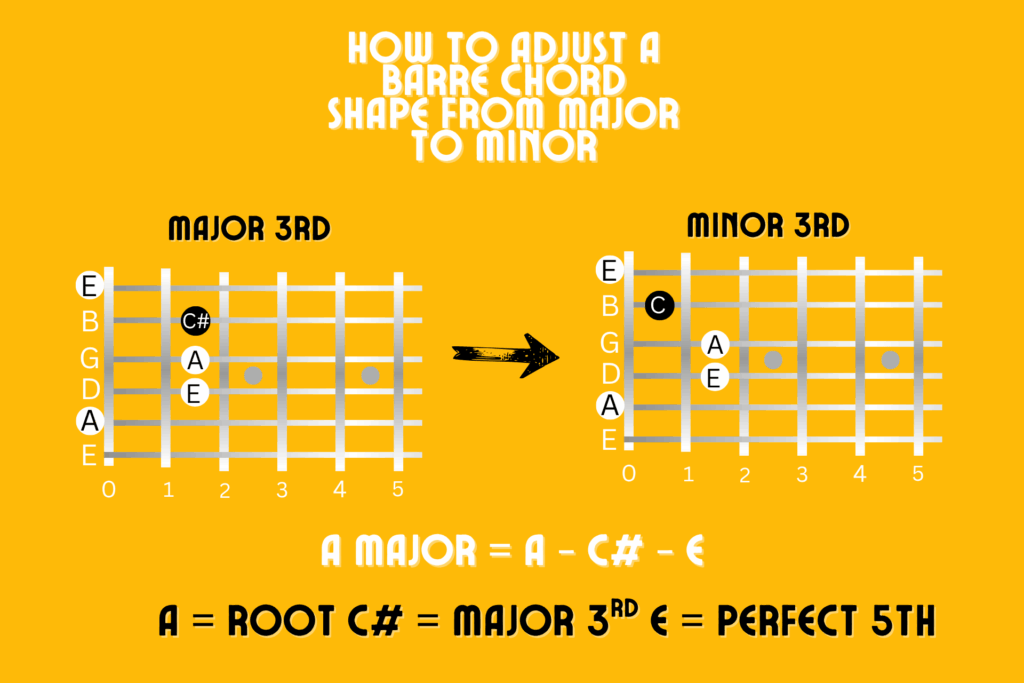
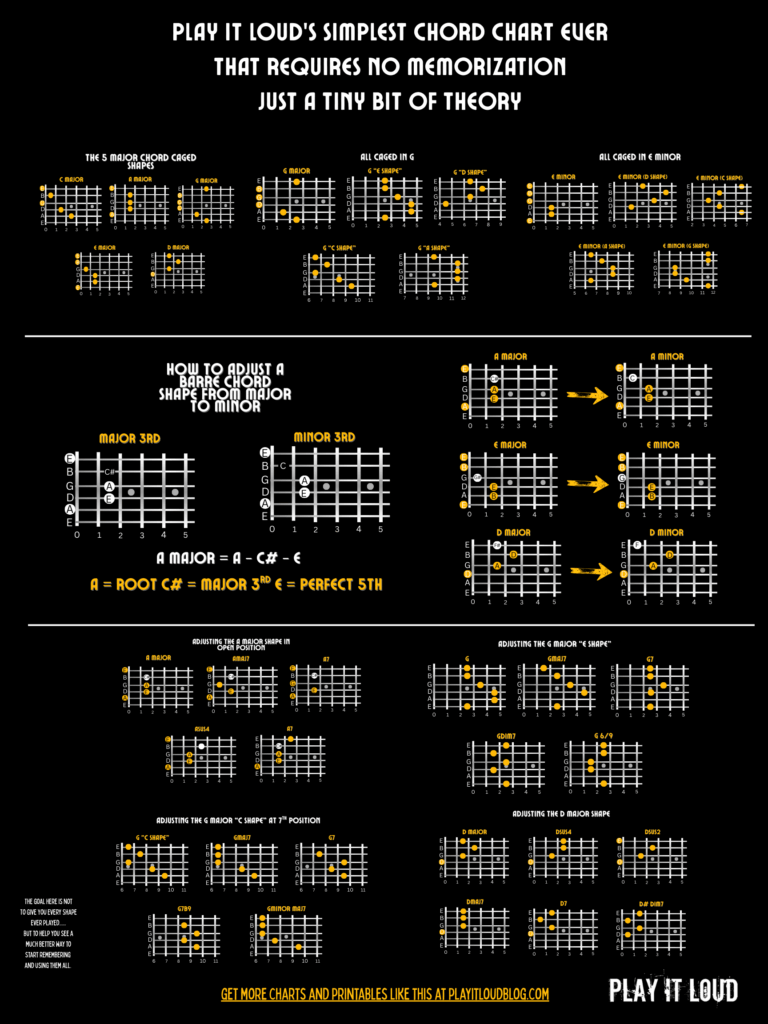
how to adjust barre chord guitar chords

It’s impossible to know what level of playing you’re at, but you may be an intermediate or advanced player if you’ve skipped to this section. 

For my beginners, the reason to learn guitar music theory like what I’m about to show you is simply because you’ll be able to remember a lot more chords using this info. 


Here’s my best tips regarding guitar chord theory:

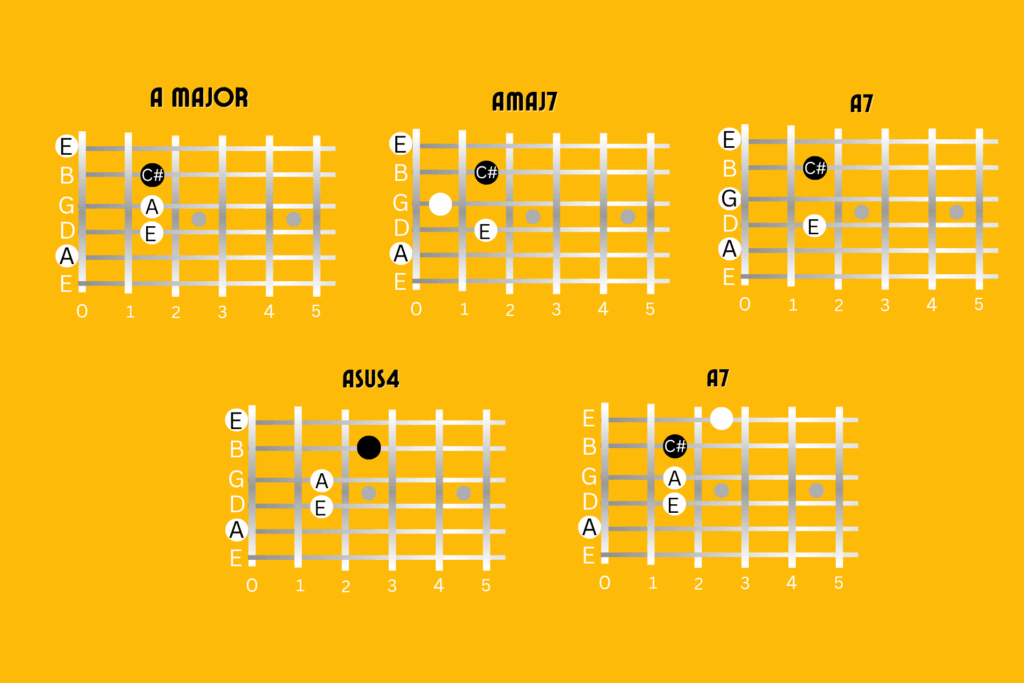
  • To turn any chord into a minor from major, find the 3rd, and lower it by 1 fret. Raise the chord shape by 1 fret to make it major from minor. 
  • To create a maj7 chord, you just need to play the note 1 fret below the root of a MAJOR chord. There are several common chord shapes for this kind of chord that come from the CAGED shapes. 
  • To create a 7th, or dominant 7th, you need to play the note 2 frets, or a whole step below the root. This is only for major chords. 
  • For a minor 7th chord shape, you do the same thing to a minor chord shape that you did to a major chord. 
 

adjusting barre chord guitar chord types in A

If you just remember these tricks, you can now play a whole lot more guitar chords that you may see in tabs. 

You see, knowing more chords is certainly about knowing a lot of shapes. 

It’s also about knowing how chords and key signatures work so that you can see closely related chords, and thus see how songs work. 

Sometime soon you’ll start hearing about I-IV-V chord progressions, I-vi-ii-V progressions, the 12 Bar Blues, and maybe ii-Vs if you get into jazz chord progressions. 


I’ll tell you briefly why this is, and we’ll use the key of G major. 

The key of G major is built off what we call the major scale formula, and it gives us the following notes: 

G (whole step) A (whole step) B (half step) C (whole) D (whole) E (whole) F# (half) G

Whole step = 2 frets up or down a string HORIZONTALLY

Half step = 1 fret up or down


To “stay in key”, in this case G major, you can only create chords from these 7 notes. 

Here’s a few chords for an example: 

G major (1st note of scale/key) = G – B – D (root – 3rd – 5th) 

D major (5th note of scale/key)  = D – F# – A (root – 3rd – 5th) 

C major (4th note of scale/key)  = C – E – G (root – 3rd – 5th)

E minor (6th note of scale/key) = E – G – B (root – minor 3rd – 5th) 


All the notes come from those 7 made from the formula of whole steps and half steps. 

If you play a note like G#, you’ll be “out of key.” 

Now try making some of the chords from the tricks I told you about: 

G becomes Gmaj7 = G – B – D – F# (F# is 1 fret below the root, G)

D becomes D7 = D – F# – A – C (C is 2 frets below the root, D) 

Em becomes Em7 = E – G – B – D (D is 2 frets below the root, E) 


This again is probably a lot of information. If there was an easier way to tell you this, I certainly would. 

Now I’m not going to reveal all my secrets here, as that’s where my courses will come in, but understanding this has massive implications…..

  • With chord theory, you can remember and create chord shapes at will whenever a song calls for one
  • With understanding of keys, and memorizing the possible major and minor chords in each one, you can more easily how understand how songs are written
  • And if you ever want to improvise your own lead guitar solos, then knowing what the best notes to play over each chord will be of immense help. 
 

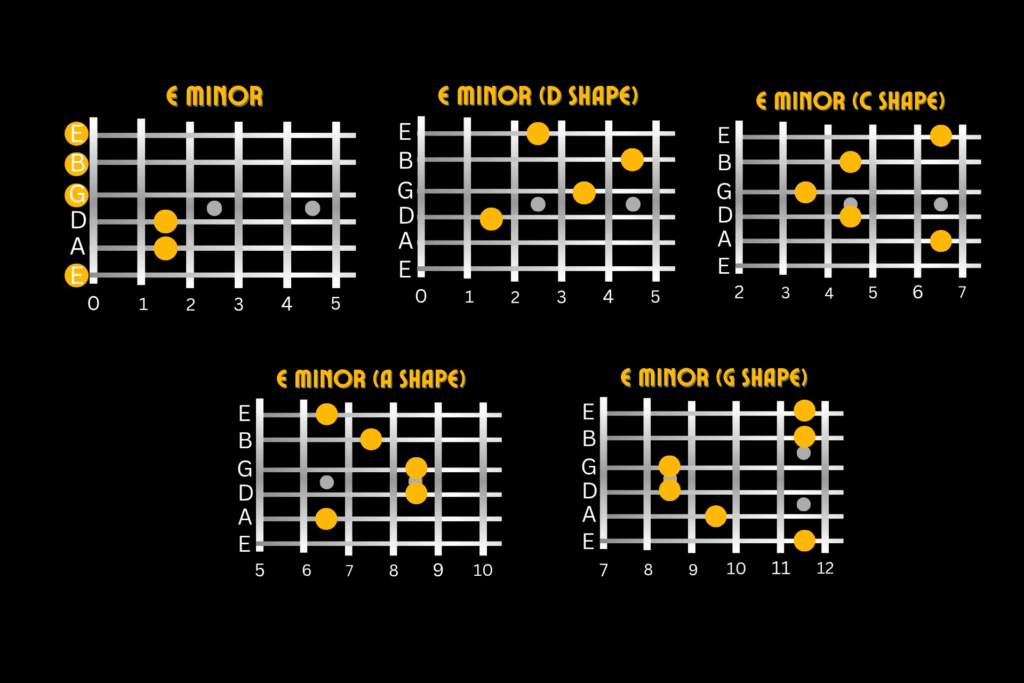
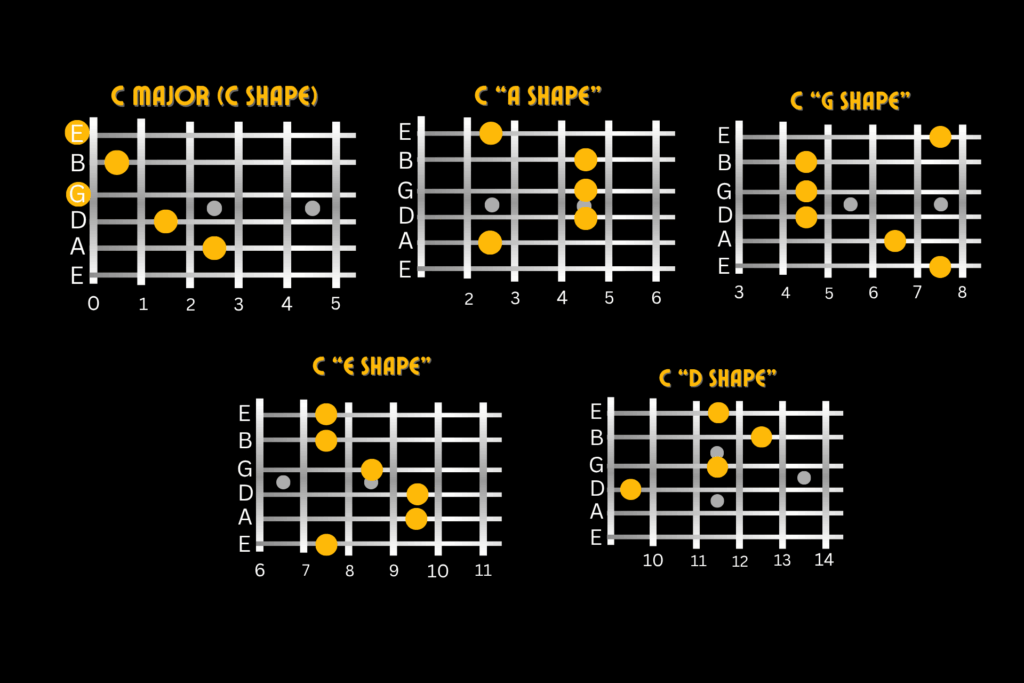
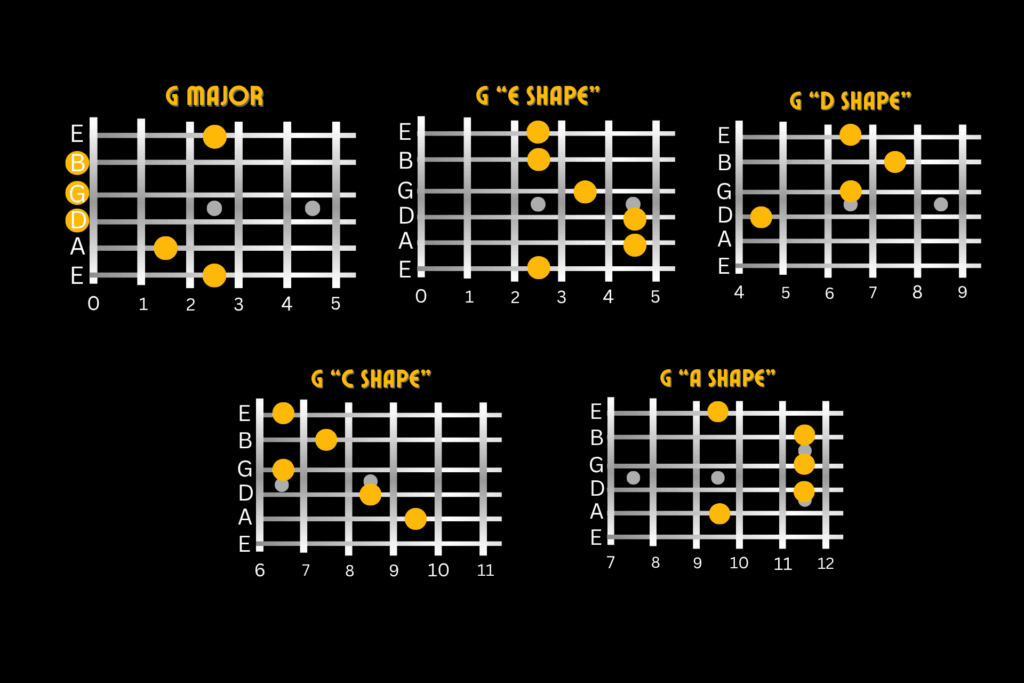
To reward those of you who have been reading this far, I made some images to help you remember some of the things I’ve just explained in this article: 
g major guitar chords e minor guitar chord shapes  

Playing 1000s Of Songs With Just These 8 Chords & Remembering Chord Shapes Easily

When I was doing research for this article, I saw all sorts of wild claims about guitar chords and learning the instrument. 

And it brought up another annoying pet peeve of playing guitar to me……

Knowing the CAGED chords is definitely going to allow you to play 1000s of songs, but its going to be really boring after awhile. 

That’s assuming your main way to play these chords is to strum them.


If you go through the 50 songs I linked to earlier, you’ll quickly start to see that all of these songs sound the same unless you’re singing over them. 

And if you read the previous section, you’ll understand why you can play 1000s of songs…..

It’s because they use the exact same chords and play in a few of the most common keys: G major, C major, D major, E minor, A minor. 

So what should you do to avoid this?

  • Learn how to fingerpick with the PIMA fingerings
  • Yes, learn some strumming patterns but don’t focus on learning all 300 or so that are available out there
  • Learn riffs as well from classic bands like Led Zeppelin, the Beatles, Metallica, Nirvana, Pink Floyd, or whoever you like most
 

I also want you to understand these realities when it comes to learning about guitar chords and playing the instrument: 

  • No song will be played exactly the same way, even if it uses the same chords as another
  • These shapes are training wheels and an easy way to remember a key sound of music: the common chords we’ve already mentioned
  • You are not bound by a musical key, the 3 notes of a chord, or what chord shape you must use. You’ll be surprised how often professional tab books and Piano-Vocal-Guitar books get things wrong that just don’t sound right. 
  • Finally, you can’t skip the part where you must remember the shapes, build muscle memory, and practice locking into the fingerings of a chord. 
All About The Almighty Power Chord and Barre Chord

power chords guitar chord chart

This is the chord shape that unconsciously got me into playing the guitar! 

It’s the backbone to metal music, punk rock, and many of the classic rock riffs you may be learning right now. It’s used by everyone from Joe Pass, Robert Johnson, and Taylor Swift. 

Here’s all you need to know about the power chord guitar chord: 

  • This shape comes from the E shape and A shapes, also known as “barre” chords because you’ll use your 1st finger to “barre” a fret while your other fingers play the other frets. 
  • To play it, you will use one of these possible fingerings: fingers 1-4-4 across 3 strings or 1-4 across 2 strings, OR fingers 1-3-4 across 3 strings or 1-3 across two strings.
  • You have to play these notes together 99% of the time you see a song use it, like any other chord we’ve talked about. 


I don’t think many others have had the reaction to the prevalence of power chords that I’m about to tell you, but it’s been annoying how often they’re used. 

Are there really no other chord shapes you can use to make hard rock music? 

Yes there are but they’re harder to use. I have a whole course about these shapes in my massive product called Pentatonic Prison Break, but sorry, I’m trying to avoid pushing my own stuff. 

Guitar Chord Chart PDF: Building Your Chord Vocabulary

You can easily google the word “guitar chord charts” and get more than enough chords to last you a lifetime and to avoid buying a guitar chord book of any kind. 

The question you probably want answered the most is “which chart is the best?” and “how should I go about using them?


Hopefully you’ve gone through the chord theory section and already know what I’m about tell you….

Instead of trying to remember tons of shapes, it’s a much better idea to understand how chords work, how to adjust shapes to your liking, and to start understanding how chords come from musical keys and scales. 

If you do this you’ll be able to assemble a chord vocabulary that looks more like the one above.  

Should You Use A Guitar Chord App? Here's What To Consider.....

My answer to this question is…..maybe. 

If you’re brand new to guitar or you’re just starting to move beyond the CAGED chord shapes then yes go for it. 

My main gripe with relying on apps is that you’re avoiding the work of understanding how chords work, and thus creating your own shapes, figuring out parts of songs by ear using this knowledge, and avoiding seeing how these shapes interconnect with intervals, scales, and other chord shapes so that you can see the whole system on the fretboard. 

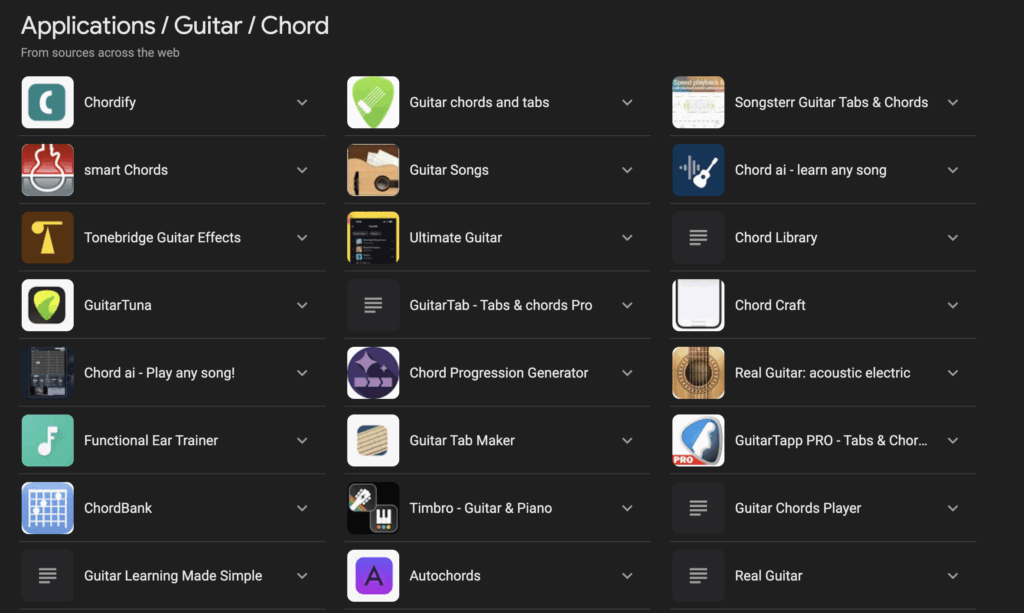
That said though, I’m going to leave a list of guitar chord apps for you to go and try out: 

  • Chordify (great way to match the changes with the lyrics in the song)
  • Ultimate Guitar (my recommendation as you’ll only use the shapes in the songs you’re learning anyways) 
  • Yousician (can’t say much about them but they do have a great design)
  • Songsterr
  • Chordbot
  • Chordbank 

Finally, A List Of Techniques To Start Using With Guitar Chords

I hope I’ve been able to answer a lot of questions about guitar chords in this article. 

I have lots of music theory printable charts and documents that can help you learn a lot more about the fretboard, as well as courses on music theory, how chords work in genres like blues and country, as well as how to solo over progressions like those I’ve mentioned. 

Let’s end this with some guitar techniques I recommend you begin using so that you won’t have to strum everything endlessly.

  • Arpeggiation
  • PIMA fingerpicking 
  • Chord melody
  • Double stop fills 
  • Pedal steel bends and unison bends
  • 6th intervals
  • 10th intervals
  • octaves
  • Percussive slaps, mutes, frails, golpe
  • Tapped basslines and fills 
  • Harp harmonics
  • Travis picking ala Chet Atkins
  • Thumb slap and pop